
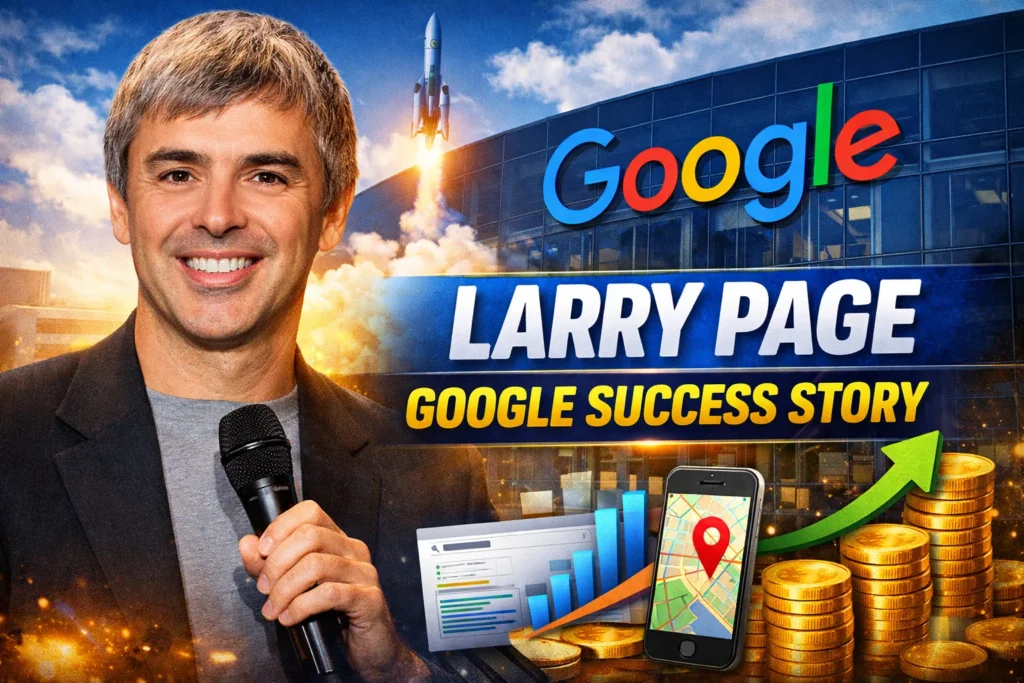
Larry Page: The Visionary Co-Founder Who Built Google and Changed the Internet Forever
Larry Page is one of the most influential technology entrepreneurs of the modern era. As the co-founder of Google, Page played a pivotal role in transforming how the world accesses information. From a humble research project at Stanford University to building one of the most powerful companies in history, Larry Page’s journey is a story of curiosity, innovation, risk-taking, and long-term vision.
Early Life and Education of Larry Page
Larry Page was born on March 26, 1973, in East Lansing, Michigan, USA. He grew up in a family deeply rooted in computer science. His father, Carl Victor Page Sr., was a pioneer in computer science and artificial intelligence, while his mother, Gloria Page, was a computer programming instructor.
Surrounded by computers, magazines, and technology discussions from an early age, Larry developed a natural fascination with how machines worked. By the time he was six years old, he had already decided he wanted to become an inventor.
Academic Background
Bachelor’s Degree: Computer Engineering, University of Michigan
Master’s Program: Computer Science, Stanford University
It was at Stanford that Larry Page’s life — and the future of the internet — would change forever.
The Birth of an Idea: From Research Project to Google
While pursuing his PhD at Stanford in 1996, Larry Page began researching how the structure of links on the World Wide Web could be analyzed mathematically. Unlike existing search engines that ranked pages based on keyword frequency, Page believed links could be treated as votes of credibility.
He teamed up with another Stanford PhD student, Sergey Brin, and together they developed a new search algorithm called PageRank—named after Larry Page himself.
BackRub: Google’s First Name
The early search engine was initially called BackRub, as it analyzed “backlinks” pointing to a webpage. The system quickly proved far superior to existing search engines in delivering relevant and accurate results.
In 1997, they renamed it Google, derived from the mathematical term “googol”, meaning 1 followed by 100 zeros — symbolizing their mission to organize infinite information.
Founding Google: From Garage to Global Powerhouse
In September 1998, Larry Page and Sergey Brin officially founded Google Inc. They started the company in a garage rented from Susan Wojcicki (later YouTube’s CEO) in Menlo Park, California.
Early Challenges
Lack of funding
Pressure to sell the technology
Competition from established search engines
Despite offers to sell Google early on, Page and Brin refused. Larry Page strongly believed in building a product first and monetizing later—a risky but visionary approach.
First Major Investment
Google received its first major investment of $100,000 from Andy Bechtolsheim, co-founder of Sun Microsystems, which allowed the company to formally launch.
Larry Page’s Leadership Style and Google’s Culture
Larry Page served as Google’s CEO from 1998 to 2001, and later again from 2011 to 2015. His leadership style was unconventional but deeply effective.
Core Beliefs
Focus on long-term innovation, not short-term profits
Hire brilliant people and give them freedom
Encourage bold, moonshot ideas
Under Page’s leadership, Google developed a culture that encouraged experimentation, creativity, and failure as part of innovation.
Google’s Rise to Global Dominance
Google’s breakthrough came with AdWords (2000), a revolutionary advertising model that generated massive revenue without compromising search quality.
Key Milestones
2004: Google went public (IPO), raising $1.67 billion
2006: Acquisition of YouTube
2008: Launch of Android operating system
2012: Google Chrome became the world’s most popular browser
Larry Page emphasized building products that improved lives, which helped Google expand beyond search into email (Gmail), maps, cloud computing, mobile software, and artificial intelligence.
Alphabet Inc. and a New Vision
In 2015, Larry Page restructured Google under a new parent company called Alphabet Inc. This allowed Google to focus on its core business, while Alphabet managed experimental projects like:
Waymo (self-driving cars)
Verily (life sciences)
DeepMind (artificial intelligence)
Page became CEO of Alphabet, shifting his focus to futuristic technologies and large-scale innovation.
Larry Page’s Net Worth and Influence
As of recent years, Larry Page consistently ranks among the top 10 richest people in the world, with a net worth exceeding $100 billion.
However, his true influence goes beyond wealth. Page reshaped how humans:
Access information
Communicate
Learn
Run businesses
Personal Life and Personality
Larry Page is known to be private, introverted, and deeply thoughtful. He married Lucinda Southworth in 2007, and they have children together.
Despite his immense success, Page avoids public attention and prefers working behind the scenes on ambitious technological challenges.
Larry Page’s Legacy and Impact
Larry Page’s legacy lies in his ability to combine technical brilliance with fearless ambition. He didn’t just build a company; he helped define the digital age.
Lessons from Larry Page’s Success
Think big and solve meaningful problems
Focus on innovation before profit
Don’t fear unconventional ideas
Build technology that benefits humanity
Conclusion
From a Stanford research project to co-founding one of the most powerful companies in history, Larry Page’s journey is a testament to the power of curiosity, perseverance, and vision. As Google continues to shape the future of artificial intelligence and global information access, Larry Page’s influence remains deeply embedded in the digital world.