
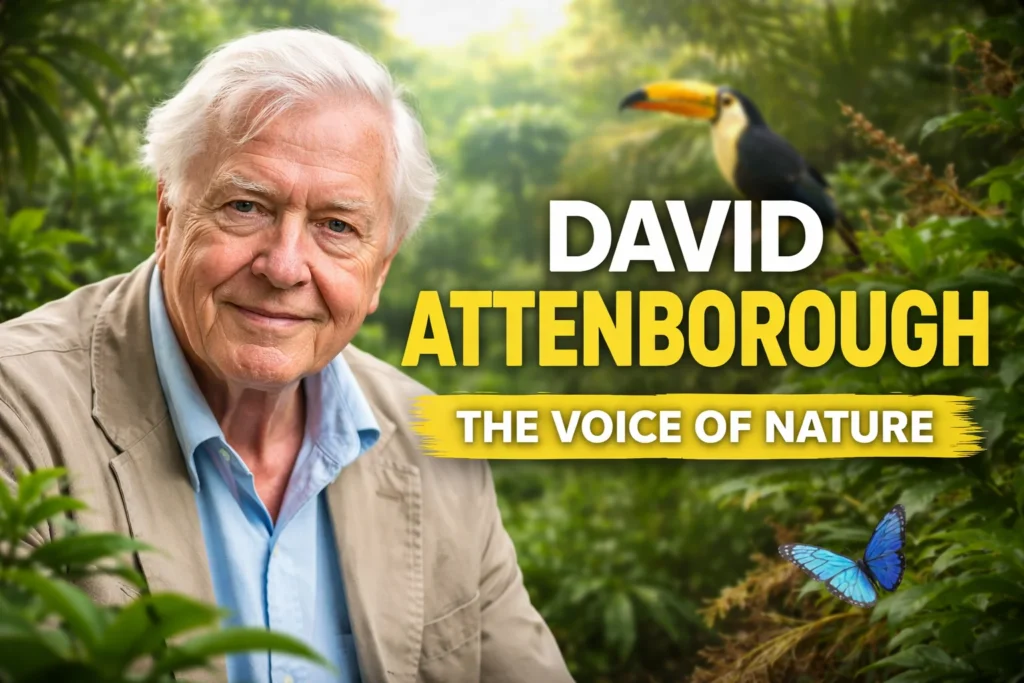
Sir David Attenborough: Life, Career, Documentaries, and His Impact on the Natural World
Sir David Attenborough is a globally respected British broadcaster, natural historian, writer, and environmental activist whose work has transformed how humanity understands the natural world. With a career spanning more than 70 years, Attenborough has become the most recognizable voice in nature documentaries and a powerful advocate for protecting Earth’s fragile ecosystems.
Early Life and Background
Sir David Frederick Attenborough was born on 8 May 1926 in London, England, into an intellectually rich family. His father, Frederick Attenborough, was a university principal, which created an environment that valued education, curiosity, and discovery. From a young age, David showed a deep fascination with fossils, insects, rocks, and wildlife, collecting specimens and spending hours studying nature.
This childhood passion laid the foundation for his lifelong dedication to natural history.
Education and Academic Foundation
Attenborough studied Natural Sciences at Clare College, Cambridge University, focusing on zoology and geology. His academic background gave him a strong scientific understanding, which later became one of the defining strengths of his documentaries. Unlike many presenters, he was not just a narrator but a true natural historian who respected scientific accuracy.
After completing his studies, he served in the Royal Navy before beginning his broadcasting career.
Entry into the BBC and Early Career
In 1952, David Attenborough joined the British Broadcasting Corporation (BBC) as a trainee producer. At that time, television was still a developing medium, and nature programs were rare. His breakthrough came with the series “Zoo Quest” (1954–1963), which took viewers to distant parts of the world to observe animals in their natural habitats.
This was revolutionary. For the first time, audiences could see wildlife outside zoos, filmed directly in jungles, forests, and deserts.
The “Life” Series and Global Recognition
Sir David Attenborough achieved worldwide fame through his legendary “Life” series, a collection of groundbreaking documentary projects that explored the history of life on Earth.
Major “Life” Series Documentaries:
Life on Earth (1979) – Evolution of life
The Living Planet (1984) – How organisms adapt to environments
The Trials of Life (1990) – Animal behavior and survival
Life in the Freezer (1993) – Antarctica’s wildlife
The Private Life of Plants (1995) – Hidden plant behavior
The Life of Birds (1998)
The Life of Mammals (2002)
Life in the Undergrowth (2005) – Invertebrates
Life in Cold Blood (2008) – Reptiles and amphibians
These documentaries combined scientific storytelling, breathtaking cinematography, and Attenborough’s calm, authoritative narration, setting a new global standard.
Planet Earth and The Blue Planet
Attenborough reached a new generation with visually stunning high-definition series such as:
The Blue Planet (2001)
Planet Earth (2006)
Planet Earth II (2016)
Blue Planet II (2017)
These productions used cutting-edge filming technology, drones, and underwater cameras to reveal never-before-seen wildlife behavior. They became some of the most-watched and critically acclaimed nature documentaries in television history.
Leadership Role at the BBC
Beyond presenting, Sir David Attenborough held influential leadership roles:
Controller of BBC Two
Director of Programmes at the BBC
He was instrumental in launching BBC Two as an intellectually driven channel and played a key role in introducing color television in the UK. His decisions helped expand educational, cultural, and scientific programming.
Environmental Activism and Climate Change Advocacy
In the later stages of his career, Attenborough shifted his focus toward environmental awareness and climate change activism. His documentaries increasingly emphasize the dangers of:
Global warming
Deforestation
Plastic pollution
Ocean degradation
Mass extinction of species
His film “A Life on Our Planet” (2020) is considered his most urgent message, describing humanity’s impact on Earth and offering solutions for a sustainable future.
Attenborough believes that humans still have time to reverse environmental damage—if immediate action is taken.
Awards and Honors
Sir David Attenborough has received numerous awards, including:
Knighted in 1985
Order of Merit (2005)
Multiple BAFTA Awards
Emmy Awards
Dozens of honorary doctorates
He is the only individual to have won BAFTA awards across five different television formats, from black-and-white to 4K ultra-high definition.
Personal Philosophy and Character
Known for his humility, calm demeanor, and moral clarity, Attenborough avoids political extremes and instead focuses on scientific evidence and ethical responsibility. He believes education is the most powerful tool for conservation and that people protect what they understand.
Despite his fame, he lives a simple life and remains deeply curious—even in his late 90s.
Legacy and Influence
Sir David Attenborough’s influence extends far beyond television. He has inspired:
Environmental movements
Wildlife conservation policies
Scientific careers
Global awareness of biodiversity
Millions credit him with shaping their understanding of nature and motivating them to care for the planet.
Conclusion
Sir David Attenborough is not just a broadcaster; he is a historian of life, a teacher to humanity, and a guardian of Earth’s future. His work reminds us that nature is not separate from us—it is the system that sustains all life. As environmental challenges grow, his voice continues to guide, warn, and inspire the world.