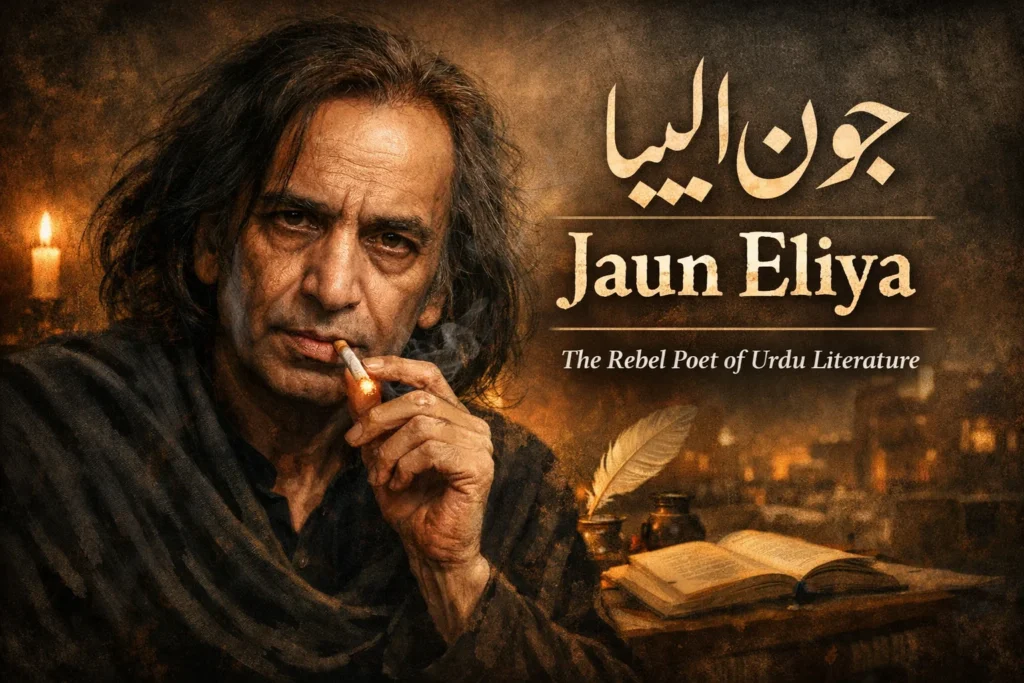
Jaun Eliya: The Poet of Existential Pain and Intellectual Rebellion
Jaun Eliya (1931–2002) was one of the most original and intellectually intense poets of Urdu literature. Known for his sharp intellect, deep philosophical insight, and unconventional thinking, Jaun Eliya transformed modern Urdu poetry by giving voice to existential despair, emotional isolation, and ideological conflict. His poetry reflects a restless mind that constantly questioned society, religion, love, and the meaning of existence itself.
Early Life and Education
Jaun Eliya was born on December 14, 1931, in Amroha, a historic town in British India. He belonged to a highly educated and scholarly family. His father, Allama Shafiq Hasan Eliya, was a renowned scholar of Arabic, Persian, and Islamic studies. This scholarly environment deeply influenced Jaun Eliya, enabling him to master several languages, including Arabic, Persian, Hebrew, Sanskrit, and English, at a very young age.
After the partition of India in 1947, Jaun Eliya migrated to Pakistan in 1957 and settled in Karachi. However, the experience of migration left a lasting emotional scar on him, which later became a recurring theme in his poetry—alienation, loss, and a sense of displacement.
Literary Career and Style
Jaun Eliya remained relatively unknown to the masses for a long time, as he published his first poetry collection Shayad in 1991, when he was nearly sixty years old. Despite this late publication, the book received immense appreciation and established him as a major modern poet. His other notable collections include Yani, Guman, Lekin, and Goya.
His poetry is marked by intellectual depth, emotional intensity, and philosophical skepticism. Unlike traditional romantic poets, Jaun Eliya openly expressed despair, self-criticism, nihilism, and rebellion against social norms. He frequently used irony and blunt language to express inner turmoil. His verses often question religious dogma, historical narratives, and moral certainty, making his poetry bold and sometimes controversial.
Themes in His Poetry
The dominant themes in Jaun Eliya’s poetry include existentialism, unfulfilled love, loneliness, migration, political disillusionment, and the conflict between reason and faith. Love in his poetry is not idealized; instead, it is painful, incomplete, and deeply personal. He portrayed himself as a failed lover and a restless thinker, which made his work highly relatable to readers facing emotional and intellectual struggles.
Another striking feature of his poetry is self-mockery. Jaun Eliya did not hesitate to expose his own weaknesses, failures, and contradictions. This honesty created a strong emotional connection with his audience and distinguished him from many of his contemporaries.
Intellectual Contributions
Apart from poetry, Jaun Eliya was a distinguished scholar and editor. He worked extensively on classical Islamic texts and contributed to research on philosophy, history, and linguistics. He served as an editor at the Ismaili Research Institute, where he played a significant role in compiling and preserving rare manuscripts. His intellectual versatility made him a rare figure who successfully bridged classical scholarship and modern poetic expression.
Legacy and Influence
Jaun Eliya passed away on November 8, 2002, but his influence continues to grow with time. Today, he is one of the most quoted Urdu poets on social media, literary gatherings, and mushairas. His poetry resonates strongly with younger generations who relate to his honesty, emotional pain, and intellectual defiance.
Jaun Eliya’s contribution to Urdu literature lies not only in his poetry but also in his fearless individuality. He challenged conventions, refused easy optimism, and embraced doubt as a form of truth. In doing so, he gave Urdu poetry a voice that was deeply human, painfully honest, and intellectually profound.
Central Themes in Jaun Eliya’s Poetry
1. Existential Despair and Self-Awareness
One of the most defining features of Jaun Eliya’s poetry is existential anguish. His poems often present the self as fragmented, exhausted, and painfully conscious of its own failures. He does not romanticize suffering; instead, he exposes it with brutal honesty. Jaun frequently questions the meaning of existence, the inevitability of decay, and the futility of human effort. This philosophical pessimism aligns him with existentialist thinkers, though his expression remains deeply rooted in Urdu poetic tradition.
His poetry suggests that awareness itself is a curse: to know too much is to suffer endlessly. This awareness turns inward, making the poet both the observer and the accused.
2. Love as Loss, Not Fulfillment
In Jaun Eliya’s poetry, love rarely offers solace. Instead, it is portrayed as incomplete, broken, or irrevocably lost. His love poems are not celebrations of union but meditations on separation, regret, and emotional ruin. The beloved often appears distant or indifferent, while the poet remains trapped in memory and longing.
What distinguishes Jaun’s treatment of love is its intellectualization. He dissects emotion rather than surrendering to it. Love becomes a site of self-criticism, where the poet blames himself for his incapacity to sustain happiness. This self-accusatory tone gives his romantic poetry a rare depth and sincerity.
3. Rebellion Against Tradition and Society
Jaun Eliya was deeply skeptical of social norms, religious dogma, and political ideologies. His poetry frequently challenges inherited beliefs and mocks blind conformity. He refused to accept ideas merely because they were sanctified by tradition. This rebellious stance makes his poetry unsettling but also intellectually liberating.
He often positioned himself as an outsider—someone who does not belong to any collective identity. Nation, religion, and social roles appear in his verse as restrictive constructs that suffocate individuality. This sense of alienation intensified after the partition of the subcontinent, which left a lasting mark on his consciousness.
4. Historical Consciousness and Cultural Loss
Jaun Eliya possessed vast knowledge of history, philosophy, and classical languages, and this learning subtly informs his poetry. He frequently laments the decline of civilizations, the loss of intellectual rigor, and the erosion of cultural depth. For him, modernity is not progress but a collapse of meaning.
His migration from India to Pakistan intensified this sense of historical dislocation. The pain of exile—both physical and intellectual—runs through his poetry. He mourns not just a lost homeland but a lost worldview in which thought, debate, and scholarship were valued.
5. Language, Tone, and Style
Stylistically, Jaun Eliya revolutionized the Urdu ghazal without abandoning its classical structure. His language is simple, direct, and conversational, yet charged with philosophical weight. He avoids excessive imagery and rhetorical flourish, relying instead on stark statements and paradoxes.
His tone is often ironic, bitter, and self-mocking. Even when expressing profound sorrow, there is an undercurrent of intellectual wit. This combination of emotional vulnerability and sharp reasoning gives his poetry a distinctive voice that feels modern, intimate, and unsettling.
Famous Poetry Collections and Their Significance
Shayad
Shayad is Jaun Eliya’s most celebrated collection and a cornerstone of his literary legacy. The poems in this book explore doubt, hesitation, and emotional uncertainty—qualities suggested by the title itself (“perhaps”). The collection captures his mature poetic voice, where love, despair, and philosophical inquiry intersect seamlessly.
Yaani
In Yaani, Jaun’s poetry becomes more introspective and fragmented. The poems reflect a deepening sense of isolation and intellectual exhaustion. Here, the poet appears more resigned, yet his critical edge remains intact.
Gumaan and Lekin
These collections further expand Jaun Eliya’s thematic concerns. Gumaan (illusion or suspicion) explores the instability of belief and perception, while Lekin (but) emphasizes contradiction and resistance. The very titles reflect his refusal to accept certainty and closure.
Lasting Impact and Popularity
Jaun Eliya’s poetry gained widespread popularity relatively late in his life, but today it resonates powerfully with younger readers. In an age marked by identity crises, emotional disillusionment, and skepticism toward grand narratives, his voice feels remarkably contemporary. His verses are frequently quoted in literary gatherings, social media, and academic discussions.
What makes Jaun Eliya enduring is his courage to articulate intellectual despair without compromise. He did not offer solutions or consolation; instead, he offered truth as he perceived it—raw, painful, and uncompromising.
Conclusion
Jaun Eliya’s famous poetry stands as a testament to the power of honest expression. His work bridges emotion and intellect, tradition and rebellion, love and loss. By refusing to mask despair with false optimism, he created a body of poetry that speaks directly to the restless, questioning mind. His verses do not seek to comfort the reader; they seek to awaken them—and in doing so, they secure his place as one of the most profound voices in modern Urdu poetry.