
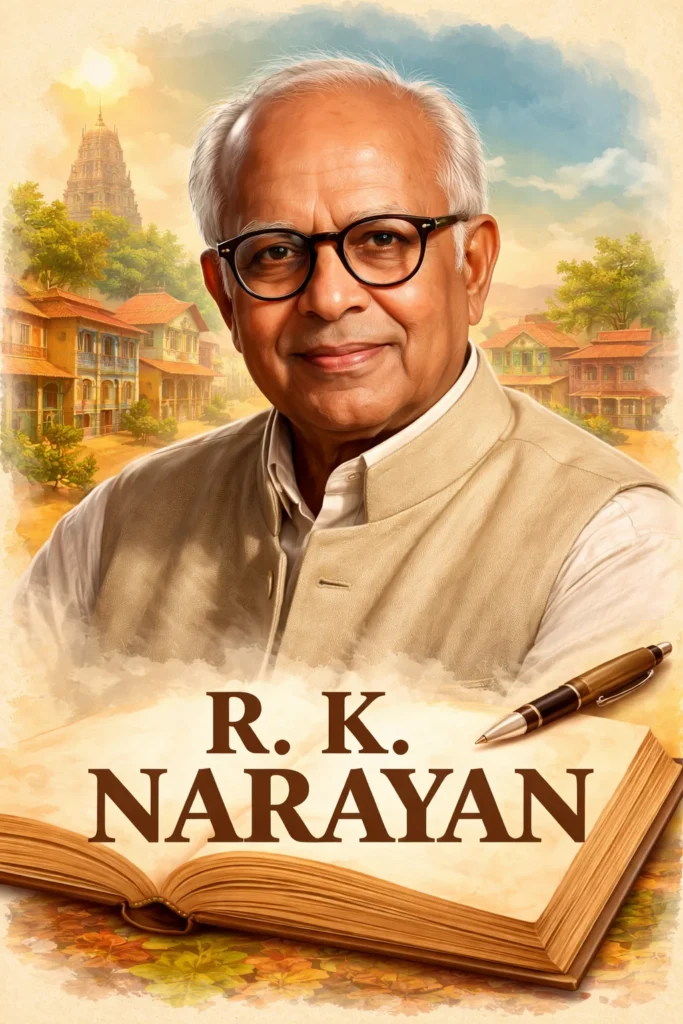
R. K. Narayan: A Pillar of Indian English Literature 2026
Rasipuram Krishnaswami Narayan, popularly known as R. K. Narayan, was one of the most influential and widely read Indian writers in English. He played a vital role in shaping Indian English fiction and presenting Indian life, culture, and values to the world in a simple yet powerful manner. His writing is admired for its clarity, gentle humor, realistic characters, and deep insight into human nature.
Early Life and Education
R. K. Narayan was born on 10 October 1906 in Madras (now Chennai), India. He spent most of his childhood in Mysore, which later became the inspiration for his famous fictional town, Malgudi. Narayan was educated at Maharaja’s College, Mysore. From an early age, he developed a strong interest in literature and reading, especially English novels. Despite facing several rejections at the beginning of his career, he remained determined to become a writer.
Literary Career and the Creation of Malgudi
R. K. Narayan began his literary career with the novel “Swami and Friends” (1935), which introduced readers to Malgudi, a small fictional town in South India. Malgudi became the backbone of his literary world and appeared in most of his novels and short stories. Through this town, Narayan portrayed the everyday lives of ordinary Indians—teachers, students, shopkeepers, clerks, and villagers—with great realism and warmth.
Malgudi was not just a setting; it was a living, breathing place that reflected Indian society in all its simplicity and complexity. Narayan used it to explore themes such as tradition versus modernity, human relationships, moral struggles, and personal growth.
Major Works
R. K. Narayan wrote numerous novels, short stories, essays, and non-fiction works. Some of his most important novels include “The Bachelor of Arts,” “The English Teacher,” “The Dark Room,” “Mr. Sampath,” “The Financial Expert,” “The Man-Eater of Malgudi,” and “The Guide.”
Among these, The Guide is considered his masterpiece. It tells the story of Raju, a tourist guide whose life takes unexpected turns. The novel earned Narayan the Sahitya Akademi Award and was later adapted into a popular film.
Narayan was also a master of the short story form. His short stories are known for their economy of language, subtle humor, and ironic endings. In addition, he retold Indian epics such as “The Ramayana,” “The Mahabharata,” and “The Bhagavad Gita” in simple English, making them accessible to a global audience.
Style and Themes
One of the most remarkable features of R. K. Narayan’s writing is his simple and straightforward language. He avoided complex vocabulary and elaborate descriptions, yet his writing was rich in meaning. His humor was gentle and compassionate, often highlighting the irony of life without being critical or harsh.
Narayan’s works focus on universal themes such as human weakness, moral conflict, faith, destiny, and the search for identity. He portrayed Indian traditions and values with respect, while also showing the impact of change and modernization on society. His characters were ordinary people, but their experiences reflected deeper truths about life.
Awards and Recognition
R. K. Narayan received many prestigious awards for his contribution to literature. He was honored with the Padma Bhushan in 1964 and the Padma Vibhushan in 2000. His works gained international recognition, and he was admired by writers and readers across the world. He also served as a member of the Rajya Sabha, the upper house of the Indian Parliament, for a brief period.
Death and Legacy
R. K. Narayan passed away on 13 May 2001 at the age of 94. Even after his death, his works continue to be widely read, studied, and appreciated. He remains a central figure in Indian English literature, especially for students and scholars.